Image

The Existential Intelligence in the Knowledge Economy Workplace [INFOGRAPHIC]

existential intelligence mrmckThe fourth in the ongoing series!

No intelligence is more significant in the knowledge economy workplace than the existential; the intelligence of the big picture, of contexts and connections. The existential intelligence goes beyond mere cognition to human intuition and archetypal themes that provide each of us with the dignity, integrity and aspiration to fulfill our true potential. Of special note are the functional literacies of this new age that are requisite to success in learning and doing. The existential intelligence gives our work meaning and purpose; it is the wrap-around that bundles all of the other intelligences into a cohesive operating system of the mind. Learn more about all the intelligences at the Surfaquarium.

Previous infographics in the series:

Multiple Intelligences In The Knowledge Economy Workplace [INFOGRAPHIC]

The Interpersonal Intelligence in the Knowledge Economy Workplace [INFOGRAPHIC]

The Intrapersonal Intelligence in the Knowledge Economy Workplace [INFOGRAPHIC]

For further reading:

MI21: Multiple Intelligences & the Global Knowledge Economy

Wearable Artificial Intelligence: What Is It & Where Is It Going?

human robot hands

Reposted from Wired Innovation Insights:

Wearables and the Internet of Things (IoT) may give the impression that it’s all about the sensors, hardware, communication middleware, network and data but the real value (and company valuation) is in insights. In this article, we explore artificial intelligence (AI) and machine learning that are becoming indispensable tools for insights, views on AI, and a practical playbook on how to make AI part of your organization’s core, defensible strategy.

AGI or strong AI is defined as the intelligence of a machine that could successfully perform any intellectual task that a human being can. For practical wearables and IoT implementations, we are working with weak AI, which studies a specific problem solving or reasoning tasks and does not attempt to simulate the full range of human cognitive abilities. There are AI applications that exhibit capabilities such as visual perception, speech recognition, and decision-making, but none at human levels. The chasm from stitching subsystems, bottom-up to fully intelligent machines is galaxies wide.

From Apple’s Siri, Google Voice Search, Google Brain, Google Translate, Xbox, Netflix, IBM’s Watson, autonomous cars, email spam filtering to credit card fraud detection, AI has already infiltrated into nearly aspect of our daily lives… and our dependence on it is only growing. So how can AI and machine learning be applied to wearables and the Internet of Things? Let’s walk through a few examples…

Read More…

A Survey of Third Grade Reading Policies Across the US

reading

Reposted from the Education Commission of the States:

The Education Commission of the States focuses on third-grade reading proficiency in a new report highlighting policies in all 50 states plus the District of Columbia. State policymakers are keenly aware of the importance of reading at grade level by third grade. Policymakers in many states have been advocating for policies aimed at three key levers:

  • Identifying reading deficiencies with state or local assessments.
  • Providing interventions for struggling readers in grades K-3.
  • Retaining outgoing third-graders not meeting grade-level expectations.

With the release of Third-grade reading policies, ECS captures current statutory provisions specifically for these three levers. This comprehensive look at third grade reading policies in all 50 states plus the District of Columbia will assist education policymakers and stakeholders as they look to continually improve early reading success for all students.

“Research clearly demonstrates the importance of reading at grade level by third grade and, unfortunately, we know that only one-third of our nation’s children are meeting this academic milestone,” said Bruce Atchison, ECS director of early learning. “Education policymakers are dedicated to ensuring their state’s students are reading at grade level by third grade. This new ECS report provides stakeholders with a complete view of policies addressing this universal education priority.”

Read More…

Read the full report here [PDF].

It’s Time for Teaching to Reclaim its Rightful Place as a Profession

teachprofession

Reposted from Becoming Radical:

Far too often unions, professional organizations, and teacher education have failed teachers and education by racing to grab a seat at the table—eager to contribute to how to implement standards, testing, and bureaucracy. All three arenas of educational leadership have failed educator professionalism by rushing to participate within the partisan political accountability movement over the past thirty years.

Leadership from unions, professional organizations, and teacher education has been overwhelming as fatalistic as the teachers I described above; diligently compromising, eagerly complying, breathlessly trying to excel at accountability and bureaucracy—in effect, leading by following.

Teachers unions, professional organizations, and teacher education have a duty to their own existence and to teachers as well as the field of education; that duty includes no longer fighting for a place at the education reform table, no longer putting organizational leadership and bureaucracy before the integrity of education as a discipline and a profession.

Read More…

Is Free & Equitable “Public” Education a Myth?

diversity

Reposted from Salon:

The gap in the mathematical abilities of American kids, by income, is one of widest among the 65 countries participating in the Program for International Student Achievement. On their reading skills, children from high-income families score 110 points higher, on average, than those from poor families. This is about the same disparity that exists between average test scores in the United States as a whole and Tunisia. The achievement gap between poor kids and wealthy kids isn’t mainly about race. In fact, the racial achievement gap has been narrowing. It’s a reflection of the nation’s widening gulf between poor and wealthy families. And also about how schools in poor and rich communities are financed, and the nation’s increasing residential segregation by income.

As we segregate by income into different communities, schools in lower-income areas have fewer resources than ever. The result is widening disparities in funding per pupil, to the direct disadvantage of poor kids. The wealthiest highest-spending districts are now providing about twice as much funding per student as are the lowest-spending districts, according to a federal advisory commission report. In some states, such as California, the ratio is more than three to one. What are called a “public schools” in many of America’s wealthy communities aren’t really “public” at all. In effect, they’re private schools, whose tuition is hidden away in the purchase price of upscale homes there, and in the corresponding property taxes.

Rather than pay extra taxes that would go to poorer districts, many parents in upscale communities have quietly shifted their financial support to tax-deductible “parent’s foundations” designed to enhance their own schools. About 12 percent of the more than 14,000 school districts across America are funded in part by such foundations. They’re paying for everything from a new school auditorium (Bowie, Maryland) to a high-tech weather station and language-arts program (Newton, MA). “Parents’ foundations,” observed the Wall Street Journal, “are visible evidence of parents’ efforts to reconnect their money to their kids.” And not, it should have been noted, to kids in another community, who are likely to be poorer.

Read More…

Image

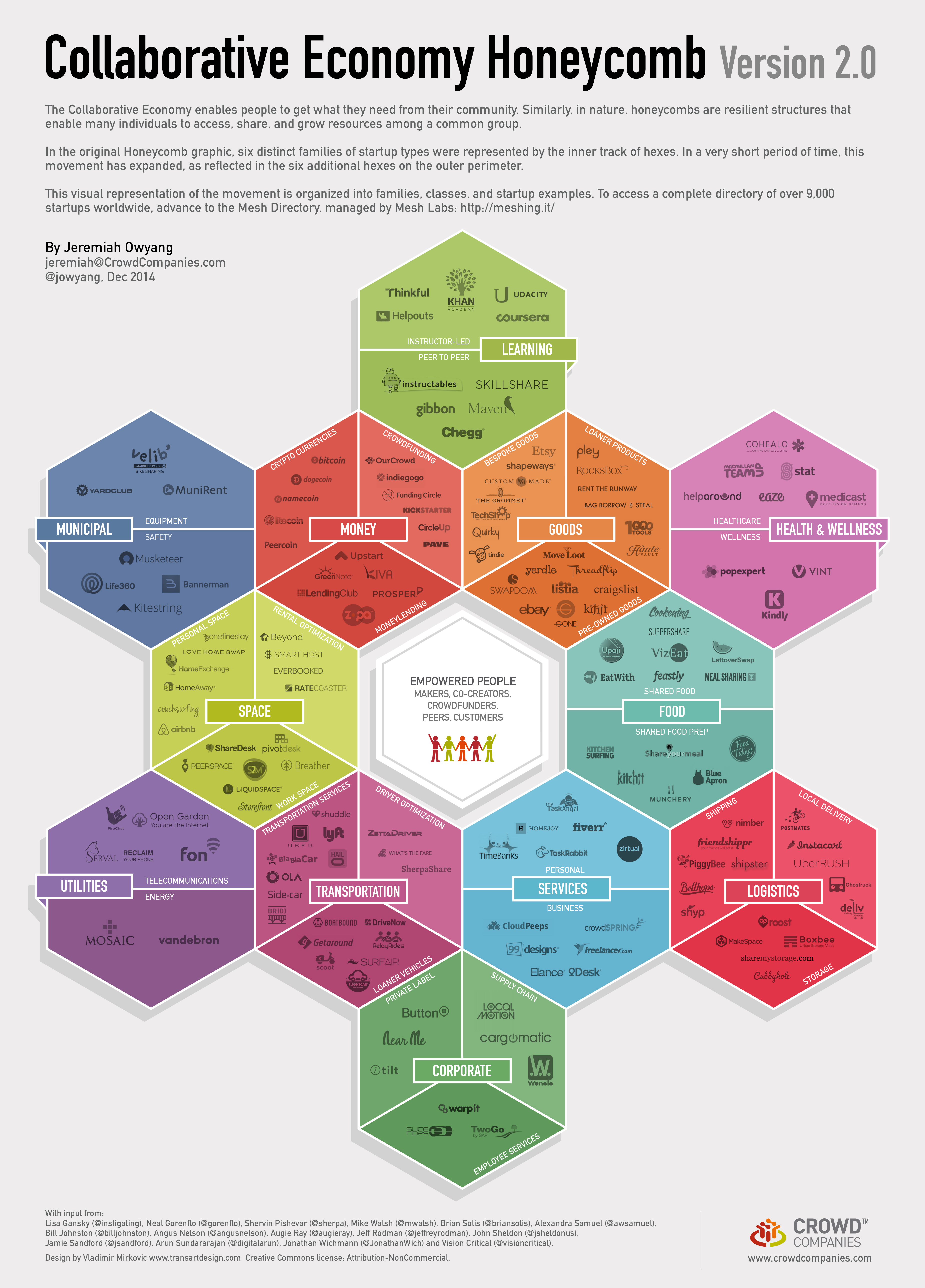
The Collaborative Economy Honeycomb [INFOGRAPHIC]

Collaborative Economy HoneycombSocial networks were the first phase of digital P2P (peer to peer) networking. They enabled anyone to create media and then share it. The Collaborative Economy is the second phase, enabling anyone to create goods and services and share them, so that individuals can access what they need to meet their personal and professional interests. Version two of the Collaborative Economy Honeycomb, created by Jeremiah Owyang, illustrates twelve families of industries, including learning, along with classes and examples of startups in each.

See the original posting of this graphic here.

Industry-Based College and Career Readiness

CCR

Reposted from EdSource:

Ensuring schools are adequately preparing students for careers is just as important as ensuring they prepare students for college, says a new paper that proposes districts add specific career-readiness measures, such as the number of students who complete work-based learning programs, to their accountability plans to the public. “Developing strong, supportive pathways that incorporate both college- and career-ready skills is our best bet for ensuring students will find their way to a productive future,” said the paper, released Tuesday by the Stanford Center for Opportunity Policy in Education, or SCOPE.

The report provides three recommendations for career preparation measures that schools should include in their Local Control and Accountability Plans, or LCAPs. The plans, required under the state’s Local Control Funding Formula for school districts, require districts to outline how they will meet eight educational priority areas mandated by the state. One of those areas requires districts to ensure that all students have access to classes preparing them for college and careers.

The report’s authors based their recommendations on a review of college and career measures in a number of states. The paper recommends that accountability plans include:

  • The proportion of students who complete career preparation programs that blend college-preparatory academics with workplace training;
  • The proportion of students who complete work-based learning experiences; and
  • The proportion of students who demonstrate they have a set of skills and knowledge in a certain field, such as those who obtain industry-approved work certificates upon high school graduation, or those who earn “virtual badges” certifying they are proficient in certain areas.

Read More…

From Instructional Design to Collaborative Solution-Finding

pd learniners

Reposted from Twist:

In the last fifteen years I’ve often been asked which technology I think will be the “gamechanger”. It comes up in conversations about everything from delivery methods to authoring tools to social platforms to mobile apps to devices and other hardware. Here’s my answer, and when I say it out loud audiences don’t much like it: The thing that is going to change the game is – the learners.

Think about a time you learned something from YouTube or some other site. Maybe it was plumbing or drywall or auto repair, or breadmaking, or magic tricks, or how to use Excel. Odds are a local community college or somesuch offers classes in that thing, so why did you go to YouTube? Because you wanted to learn it right then, for free, without driving somewhere, in the 10 minute bit you needed. Because you had a leaking faucet that needed to be repaired that night. Because you suddenly had an urgent work assignment that required some spreadsheet display you didn’t know how to do. Because you can choose from 150 videos, and make an educated choice because of upload dates, or view counts, or user ratings and comments.

Those of us in the industry get this. But now our learners are getting it, too. We’re living in a world where people have figured out that if they don’t know how to do something they don’t have to wait 2 months and pay to take a day-long class. They are identifying their own learning needs and choosing from available options the ones they feel best suit their own situations. Not only can they do it, they are starting to expect it. And they are doing it for each other. Go look at YouTube, or Snapguide, or product discussion forums, or any number of other sites where individuals are creating and posting help just for the purpose of sharing it with others.

Read More…

Image

The Future of Infographics [INFOGRAPHIC]

future infographicsColumn Five, a data visualization company out of California, offers a peek of what’s to come. Just make sure you don’t spend too long looking at the pretty pictures, because from modular design to divisible content, there are plenty of valuable tips on how to stay ahead of the visual storytelling curve.

View the original post here.

On Ulysses, Yoda And The School of Hard Knocks

hard knocks

What image pops into your head when you hear “The School of Hard Knocks?” It’s a classically rough-around-the-edges, romantic, ideal lauded in the industrial age; a solitary image standing defiantly against adversity. Because in an age of engines and systems and machines, there was fear that industrialization would rob individuals of dignity and value. Our lore is full of rugged individuals as heroes:  Ulysses, Spartacus, Rob Roy, Davy Crockett, Molly Pitcher, John Henry and Jesse James. In our modern media-driven world, entertainers have built their careers portraying characters beating the odds as the loner-hero: Humphrey Bogart, John Wayne, James Dean, Sean Connery, Robert De Niro, Clint Eastwood and James Gandolfini, to name a few.

The School of Hard Knocks comes with a pro-middle class, anti-intellectual edge to it; valuing life lessons over book learning. Having common sense, street smarts, cunning and cleverness makes one “cool” while being a nerd, geek, wonk or bookworm does not. It defines both how we look at ourselves and how we look at others. Rarely is communal leadership celebrated over the iron will of a larger-than-life individual stepping forward from the backdrop of everyday life. Baby Boomers idealized the School of Hard Knocks as a statement about retaining individual identity and charisma, but on its flipside, it’s also an ignorant, opinionated, mythology-based belief system justifying the vehement suppression of anything and anyone threatening one’s quality of life.

hard knocks2

Here are eight lessons celebrated by self-proclaimed graduates the School of Hard Knocks:

  • Win at all costs – whatever it takes to maintain and sustain a certain quality of life must be done, even when it flies in the face of societal values, morals and ethics.
  • Beat the system – if you can get away with lying, stealing and cheating in order to avoid conforming to societal norms, you win.
  • Stomp the competition – on whatever side of an issue you stand, your primary objective is to destroy those who oppose you so that you can achieve your goals with minimal resistance.
  • Might makes right – after ideas are vetted and the dialog is done, whoever has the ability to physically defeat others is right, whether the merit of their ideas carried the dialog or not.
  • Competition over cooperation – winning ideas rise to the surface as a result of no-holds-barred competition that pits people against one another, leaving a trail of losers behind.
  • Survival of the fittest – those who rise into positions of power and influence are superior to those who do not have the innate abilities to make their own claim to self-determination.
  • Ruling class – established classes of people within a society have the right to do whatever it takes to maintain their status, even at the expense of other classes of people.
  • Nice guys finish last – if you live your life with integrity, you will not have the same quality of life as those who are willing to break the rules and take shortcuts to be successful.

The poverty and injustice and oppression created for others by these platitudes is the very adversity the School of Hard Knocks claims to fight; the assumptions and convictions handed down to us from those who survived the Great Depression and two world wars, now being challenged by our children. Twenty and thirty-somethings demand a more just, fair, equitable society where everyone is valued equally and the common good trumps individual interests. They do not celebrate, nor do they wish to matriculate to, the School of Hard Knocks. The physical world of the industrial revolution has given way to a virtual world where there are no physical limits and anything is possible; and the ultimate truth of this virtual world is, the only thing that holds us back are the limitations we impose on our own thinking.

hard knocks3

Today our issues are global, our world is shrinking, and there are no simple, single, right answers. Adults age forty and younger celebrate collaboration, diversity and the collective good. What is the metaphor for this new age? Think about its characteristics. No boundaries. Personal choice. Social capital. Communal norms. Global collaboration. Work life balance. Communication. Mobility. Adaptability. Transparency. In many ways we are aspiring to a new image of that shining city on a hill, where success comes from contributing to the community and being responsible for the common good. The only difference is, this time around, the city is not in a physical location, it’s virtual; and equitable access and opportunity, free from poverty, injustice and oppression, are the right of every citizen.

The question we face in education is, how do we serve a cyber city on a hill? We have certainly been moving away from the industrial model of desks and chairs in orderly rows. But we’re still working within the confines of grading scales, chronological-age-based grade levels and curricula organized by scope and sequence. There’s more work to be done. The good news is today everyone values learning: vibrant, meaningful, engaging, authentic learning. The School of Hard Knocks is imploding, consumed within is own black hole. Forget John Henry and Jesse James. Think Yoda: “There is no try. Relevant and respected, education must be. Evolve, we must!”

hard knocks4